
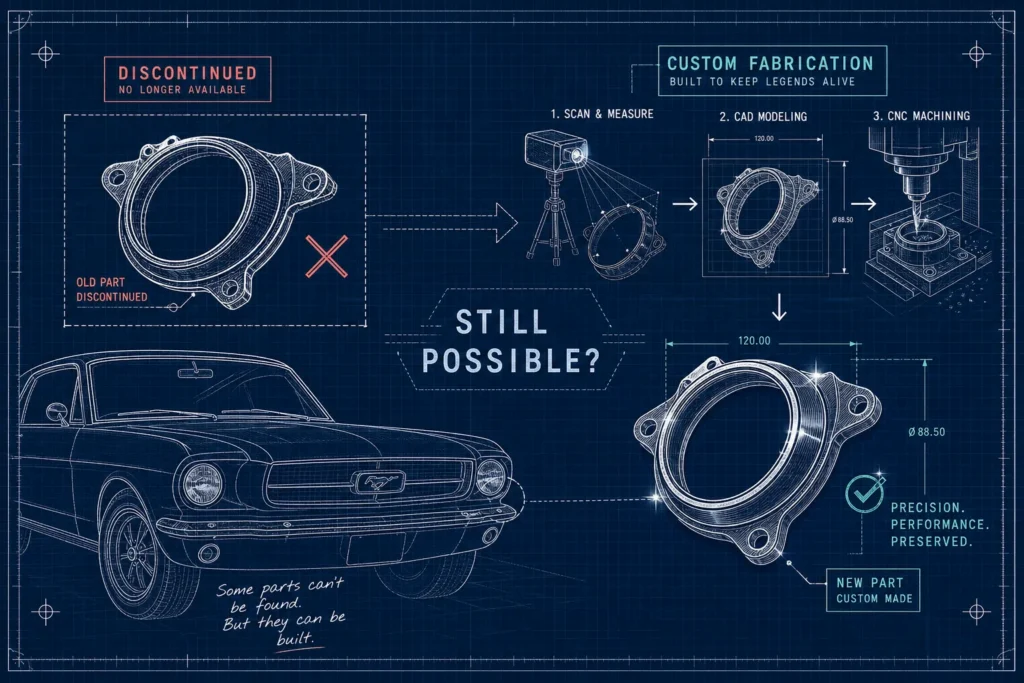
You’re deep into a Mustang or Camaro restoration. The project is moving forward, then it stops. One part number comes back discontinued from every supplier you try. The donor car market is dry. Forums give you sympathy but no solutions. It’s one of the most common stalling points in any serious classic car project, and for a lot of owners it’s where the build sits for months, or years, while the rest of the car waits.
So, can discontinued classic car parts be custom fabricated? The short answer is yes, and it is far more accessible than most owners assume. At London Car Restorations on Fitzroy Street, we’ve been recreating obsolete components for American classics for well over a decade. Mustang inner wing brackets, Camaro floor sections, year-specific trim pieces that the aftermarket has never bothered to tool up. The capability is there. What most owners lack is a clear picture of how the process actually works.
This article covers the fabrication methods available, realistic costs and lead times in the UK, the safety and legal considerations that matter before any fabricated part goes on a road car, and how to get started whether you’re bringing a physical part, a photograph, or just a problem.
Why classic car parts vanish from the supply chain
Original parts have a lifecycle, and for most American classics it ended a long time ago. Tooling gets scrapped, supplier companies consolidate or close, and the economics of a remanufacturing run rarely stack up when you’re talking about low production numbers from 50-plus years ago. Aftermarket reproduction suppliers fill some gaps well, particularly for the most popular variants of the most popular models, but for less common trim levels or model-year-specific components, the volumes simply don’t justify the investment.
The categories that disappear first tend to follow a clear pattern. Body-specific brackets and inner structure pieces go early because they’re invisible in glamour photography and rarely discussed in marque literature. Model-year-specific trim pieces, carburettor and intake components for less common engine options, and interior mouldings unique to a single production year all fall into the same trap. The rarer the option, the more year-specific the part, and the lower the original production volume, the more likely you are to hit a genuine blank in the supply chain. No catalogue, no matter how comprehensive, can fill every gap.
Can discontinued classic car parts be custom fabricated? Methods explained
CNC machining and hand fabrication for metal parts
For metal brackets, housings, and precision structural pieces where dimensional accuracy is non-negotiable, CNC machining is the strongest option. It produces consistent, production-grade parts and handles tight tolerances well. The trade-off is cost on one-offs, since setup time is real and material waste can be higher than additive processes. For a single bracket or housing, machining from billet is often the right call, because the accuracy justifies the expense.
Hand fabrication occupies a different space. It’s the most practical approach for one-off sheet-metal repair sections, patch panels, and parts that have to be shaped directly against an ageing vehicle. A skilled fabricator can work from a photograph, a mating surface, or even a rough template when nothing else exists. It’s labour-intensive and less repeatable across multiple identical parts, but it is uniquely flexible in a way that no other process matches. For floor sections and inner panels on first-generation Camaros and early Mustangs, mild steel hand fabrication to original gauge is almost always the correct approach, preserving factory dimensions and making subsequent welding and repair straightforward.
3D printed classic car parts and vacuum casting for trim and interior plastics
For non-structural components with complex geometry, trim knobs, lenses, bezels, and interior plastics, 3D printing has become the go-to method for reproducing discontinued car parts. It’s fast for one-offs, requires no tooling, and can reproduce shapes that would be prohibitively expensive to machine. Surface finish often needs post-processing, and it isn’t appropriate for high-heat or high-load applications, but for cosmetic components it works very well.
Vacuum casting is a step up for small batches where a moulded appearance matters. A master pattern is produced first, then used to make a silicone mould, which allows short runs of plastic-like parts without the cost of production injection tooling. The mould life is limited and part durability is below that of injection-moulded production components, but for rare trim pieces where you need three or four identical examples, it’s often the most sensible route.
Pattern casting for original-spec cast metal reproduction
When the missing part was originally a casting, machining from solid billet can be uneconomical and may not replicate the material character that matters for concours accuracy. Pattern casting, where a pattern is made and then used to produce a foundry casting, is the right answer here. It adds lead time and requires a good master or reverse-engineered pattern before anything goes into the mould, but it reproduces both the geometry and the material family of the original in a way that other processes cannot.
It’s worth noting that all three methods above assume some physical reference exists, whether that’s the part itself, a mating component, or detailed period photography. When nothing survives at all, a different approach is needed.
Reverse engineering when no original part exists
The harder scenario is not just a discontinued part, but no physical example anywhere. No donor car, no museum car to photograph, no owner with the original in hand. This is where reverse-engineering becomes part of the fabrication process. The starting point is gathering whatever evidence exists: photographs from period sources or registry cars, scans of mating components or the cavity the missing part sits in, and the surrounding assembly geometry.
For many brackets and covers, the fit interfaces tell you most of what you need. The bolt patterns, clearance dimensions, and load paths can be inferred from the parts that do survive, and the nominal geometry of the missing component can be reconstructed around them with a high degree of confidence. Structured light 3D scanning, where available, captures geometry to within fractions of a millimetre on surviving reference areas. Working from photographs alone, accuracy drops significantly and depends on image quality, known reference dimensions, and the simplicity of the shape. For critical features such as bores, threads, and sealing faces, direct measurement or inference from mating parts is essential. For non-critical geometry, approximation is usually acceptable and does not compromise function.
Cost and lead time: what to budget for custom fabricated classic car parts
Realistic UK cost ranges for fabricated classic car parts vary considerably by part type and complexity. UK specialist workshop labour for custom metal fabrication typically runs at £50 to £80 per hour, and even an apparently simple part accumulates hours once pattern-making, jigging, trial fitting, and finishing are included. The figures below reflect one-off and small-batch pricing for the most common part categories.
- Simple brackets: £80 to £300 for a one-off; £30 to £120 each in a small batch
- Sheet-metal panels: £300 to £1,200 for a one-off; £150 to £500 each in small batches
- Decorative trim: £200 to £1,500 for a one-off; £80 to £400 each in small batches
- Small mechanical housings: £1,500 to £5,000-plus for a one-off; from £800 each in small batches
Several factors drive cost up, and understanding them helps you keep the job reasonable. Whether a CAD model or pattern already exists makes a significant difference: providing a good physical sample, clear photographs, and any original drawings cuts time directly. Surface finish and material requirements add cost, particularly when plating, polishing, or period-correct finishes are specified. Batching multiple fabrication jobs together in a single workshop visit is one of the most effective ways to reduce per-part expense, since setup and pattern-making costs are spread across more than one component.
Safety and legal checks before the part goes on the car
Fitting a custom-fabricated part to a road car carries legal obligations that owners need to understand before work begins. A vehicle that has been substantially modified may lose its historic MOT exemption, even if the chassis date would normally qualify it. Structural changes, including chassis work or major bodyshell repairs, can require DVLA notification using form V627/3 so that the V5C reflects the modification. If fabrication work pushes the vehicle into a significantly altered category, it may require an Individual Vehicle Approval inspection before it returns to the road.
The clearest line to draw is around safety-critical components. Brake parts, steering arms, and anything that contributes to structural integrity during an impact need to be fabricated to an appropriate road-use standard, not just a fitment standard. Keep records of the materials used, welding processes, and any inspection carried out. Inform your insurer before driving the car, because an undisclosed modification to a braking or steering component can invalidate your cover. For these parts, the cost of proper documentation and validation is never optional.
How an in-house specialist shop approaches fabrication
Having fabrication capability in-house, rather than contracting work out to a general engineering shop, changes the outcome on a classic car project. The fabricator understands the part in context, knows how it interacts with surrounding components, and can trial-fit and adjust within the same workshop. For American classics, where mounting points, material gauges, and period-correct finishes matter, that context is not a minor detail. It’s the difference between a part that fits and one that fits correctly.
At London Car Restorations, in-house fabrication work on American classics has covered recreating inner wing brackets discontinued for early Mustangs, fabricating replacement floor sections to original-gauge mild steel for first-generation Camaros, and producing one-off trim brackets for models where the aftermarket has never tooled up. These aren’t unusual jobs for us. They’re a regular part of how restoration projects on rare or low-volume variants actually get finished.
The first step is a conversation. Bring the car in, or bring photographs and measurements of the missing component, and we can advise on the most appropriate fabrication method, provide a cost and lead time estimate, and confirm whether the part type raises any safety or MOT considerations before work begins. That conversation is the point at which a stalled project starts moving again.
Moving your project forward
To put it plainly: discontinued classic car parts can be custom fabricated, and the technology and specialist knowledge to do it properly is accessible in the UK. Whether you need a CNC machined vintage part, a hand-formed panel, or a 3D printed classic car component, the right fabrication method depends on the part’s material, complexity, and quantity. Cost and lead time scale with that complexity. Safety-critical parts need proper documentation and legal compliance before they go back on the road.
For owners of American classics stuck on a missing component, the choice is between a project that sits waiting indefinitely and one that moves forward with the right support. London Car Restorations exists to solve exactly this kind of problem. Bring the part, the photographs, or just the problem itself, and let the work begin from there.