
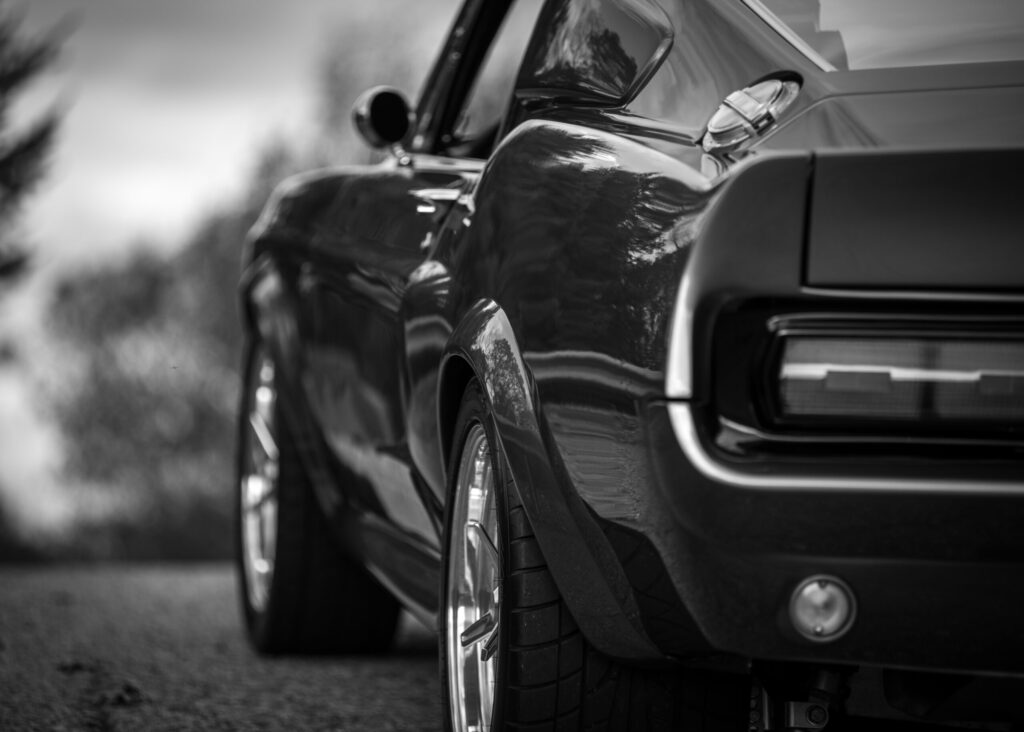
Should you restore your muscle car to show or driver standard? It’s the first real decision you face, and it isn’t about paint colour or engine spec. It shapes everything: your budget, your timeline, what materials go into the build, how you insure it, and whether you’ll ever actually drive the thing.
At London Car Restorations’ Fitzroy Street workshop, we have this conversation before any spanner is picked up. It’s the most important conversation of the entire project. Many owners we meet haven’t fully decided which path they want before they start making calls. This article gives you a clear, honest framework to work through it properly.
What concours and driver-standard restoration actually mean
A concours restoration aims to return a car to factory-correct condition in every visible and hidden detail. Panel gaps, wiring looms, underbay stencilling, hose clamps, period-correct fasteners: all of it is scrutinised and judged. The term comes from concours d’élégance events, where trained judges score each car against original factory build records. This isn’t just cosmetic work; it’s a philosophy of obsessive historical accuracy backed by documentation, and it typically means the car is trailered to events rather than driven to them.
Driver-quality restoration produces a car that looks excellent, runs reliably, and gives you the confidence to actually use it. Mechanicals are rebuilt to a high standard, bodywork is straight and well-finished, and the interior is clean and correct. The build doesn’t obsess over hidden stampings or the precise torque spec of a period-correct bolt. The result is a car that earns its keep on weekend drives, road trips, and car meets rather than sitting behind velvet ropes.
A restomod sits in its own category: original looks combined with selective modern upgrades, such as disc brakes, fuel injection, and refreshed suspension geometry. It creates a car that’s more predictable and safer to drive without altering its visual identity. It isn’t a concours car and isn’t trying to be; it’s a driver car taken up a level in real-world usability. Understanding where you sit among these three paths is the first honest decision of any restoration project.
Should you restore your muscle car to show or driver standard? The cost and timeline gap is larger than most owners expect
A well-executed driver-standard restoration on a typical muscle car, whether a Mustang, Camaro, or Chevelle, runs between approximately £32,000 and £58,000 (broadly equivalent to $40,000, $75,000 in US market terms) and takes roughly 12 to 24 months to complete properly. That range reflects 800 to 1,500 labour hours and covers a full mechanical rebuild, bodywork, paint, and a clean interior. It’s a serious investment, but the scope is manageable and the timeline predictable.
Concours-level restoration starts at around £80,000 and regularly exceeds £160,000 for highly desirable cars with complex factory detail. Labour hours often exceed 3,000 and can reach 4,000 to 5,000 on the most demanding projects. The disassembly alone is more thorough: every component is documented, sourced to period-correct specification, or hand-fabricated where NOS parts are unavailable. Timelines run from three to five years; rushing the process compromises the result. Note that figures vary by model and market; UK labour rates and parts sourcing costs will influence your final number.
Material choices drive much of the gap between the two standards. Driver-quality work uses quality modern equivalents where period parts are unavailable; concours work requires OEM-spec or NOS components, bead-blasted and correctly finished surfaces, and factory-matched paint sourced from batch documentation rather than a colour swatch. A cost breakdown by system illustrates this clearly (figures shown as indicative US market benchmarks; UK equivalents will differ):
- Bodywork: £4,000, £12,000 at driver standard versus £60,000, £120,000 at concours level
- Paint: £6,000, £20,000 at driver standard versus £8,000, £32,000 at concours level
- Drivetrain: £4,000, £13,000 at driver standard versus £6,000, £20,000 at concours level
- Interior: £2,000, £8,000 at driver standard versus £10,000, £40,000 at concours level
Every compromise a driver restoration accepts on practical grounds, a concours build rejects on principle. That’s not a criticism of either approach; it’s simply the honest reality of what each path demands financially.
What ownership really costs once the restoration is done
Running costs: driver-standard cars
A mechanically sound, driver-standard restored muscle car is genuinely usable without constant anxiety. Routine maintenance typically runs a few hundred to around £950 per year, with total annual ownership sitting in the £6,500, £11,000 range for a well-maintained collector car when you include climate-controlled storage, insurance on an agreed-value policy, and consumables. You drive it, service it, and enjoy it. That’s the deal.
Running costs: concours cars
A concours car carries a different financial rhythm entirely. The restoration cost is the starting point, not the finish line. Professional concours preparation and detailing ahead of a major event runs from £3,500 to over £18,000 depending on the vehicle and the competition level. Climate-controlled storage is non-negotiable rather than optional. Insurance reflects the higher agreed value. The car isn’t really used between events; it’s managed and maintained as a preserved artefact, a fundamentally different ownership experience.
On insurance specifically, driver cars generally attract straightforward agreed-value classic car coverage, with annual premiums typically in the £800, £1,300 range for well-specified policies. Concours cars insure at higher values, attract stricter underwriting, and often require specialist agreed-value policies that account for the full restoration cost. Add trailer ownership or hire to move the car safely to events and the annual overhead climbs again. Neither set of costs is unreasonable given what each car represents; they simply need to be planned for honestly from the beginning.
How each approach affects resale value and auction outcomes
For the right car, a concours restoration can dramatically multiply auction results. To illustrate the scale of the premium, Hagerty’s Price Guide data for a comparable model shows a driver-condition example selling at roughly $10,300 while a concours example trades at around $50,600, figures cited here as US market benchmarks rather than guaranteed UK equivalents. That gap is real, and it’s why serious collectors pursue this standard for rare, numbers-matching cars where the provenance genuinely supports it.
The difficulty is that even at those price levels, the restoration cost frequently exceeds the sale price. A situation where a £120,000 restoration yields a car that sells for £95,000 is not an unusual outcome, it’s an illustration of a pattern common enough that any owner considering concours work purely as an investment should factor it in carefully. Driver-standard restorations cost less to execute and appeal to a broader pool of buyers: enthusiasts who want to drive the car, not just display it. That wider market makes it easier to recoup the investment when the time comes to sell.
Originality is the variable that changes everything in this calculation. Numbers-matching drivetrain, documented factory options, and verifiable provenance command the strongest premiums regardless of restoration level. Concours work pays best when it restores and preserves what was originally there; it pays poorly when it introduces deviations from factory specification, however well-intentioned. Before committing to a concours brief, establish honestly what level of originality the car actually has. If the answer is “limited,” the driver path almost certainly makes more financial sense.
Restomod upgrades: what works, what collectors accept, and what UK rules say
For a driver-quality build, a handful of upgrades deliver the majority of real-world improvement. Four-wheel disc brakes are the most impactful single change; fuel injection or modern engine management solves cold-start reliability and everyday driveability; coilover suspension with refreshed geometry transforms confidence on modern roads; LED lighting improves safety after dark. These are the changes that turn an interesting machine into one you’ll actually use regularly and trust on a long run.
The modifications most accepted by the collector market share two characteristics: they are tasteful and reversible. Discreet air conditioning, period-appropriate engine management, and modernised brakes and suspension are all broadly accepted when executed well. What causes collector pushback is heavy custom bodywork, non-period engine swaps that change the car’s character, and permanent alterations that close off the option to return the car to original specification. The practical rule is straightforward: make it safe, then reliable, then comfortable, in that order.
In the UK, the 40-year MOT exemption applies to vehicles first registered more than 40 years ago that have not been substantially changed. A like-for-like restoration generally preserves that exemption; substantial modifications to major technical components, frame changes, axle alterations, or significant engine swaps, can remove it and require annual MOT testing. Even when a car is exempt, the keeper carries full legal responsibility for its roadworthiness. After a major restoration, a voluntary MOT or specialist safety inspection is the sensible move regardless of exemption status. It’s a small cost against the peace of mind it provides.
Three questions that cut through the noise
Before any work is commissioned, answer these three questions honestly:
- How do you actually want to use the car? Show trailer or weekend drive?
- What is your realistic budget? Including ongoing costs, not just the restoration invoice.
- What does the car’s provenance support? Does its originality justify the concours premium, or would a driver-quality build better match what you’ve actually got?
Most owners, on honest reflection, find the driver path is the right one for their situation.
At our Fitzroy Street workshop, we work with owners at both ends of this spectrum, from bare-metal, judged-level concours projects to sympathetic driver restorations that make a classic genuinely usable again. We don’t push a standard to inflate a project; that’s our practice and the basis on which every project here is scoped. We help you map your goals, your budget, and your car’s actual condition to the restoration path that makes sense. A conversation before any work starts costs nothing and makes everything that follows more efficient. That is how every good project begins.
Choosing the right restoration path is the whole game
Neither concours nor driver-standard is objectively better; they serve different purposes and different owners. Concours restoration is the right choice when the car’s rarity and originality justify it, the budget is genuinely available, and the goal is competition or long-term collection. Driver-standard restoration is the right choice for everyone who wants to own and actually use a great muscle car without it becoming a financial obligation rather than a pleasure.
The worst outcome is choosing the wrong standard for your situation: an under-resourced concours project that stalls halfway through, or an over-built driver car that never returns its cost. Both happen more often than they should, and both are avoidable with clear thinking at the start. Get clear on how you want to use the car, be honest about what its provenance supports, and commission the restoration that fits the answer.
If you’re still asking yourself, “Should I restore my muscle car to show or driver standard?”, we’re happy to talk it through. Whether it’s a Mustang, Camaro, Chevelle, or another American classic, contact us at our Fitzroy Street workshop for a straightforward conversation about what your car needs and what makes sense for your goals. Good work starts with that conversation.