
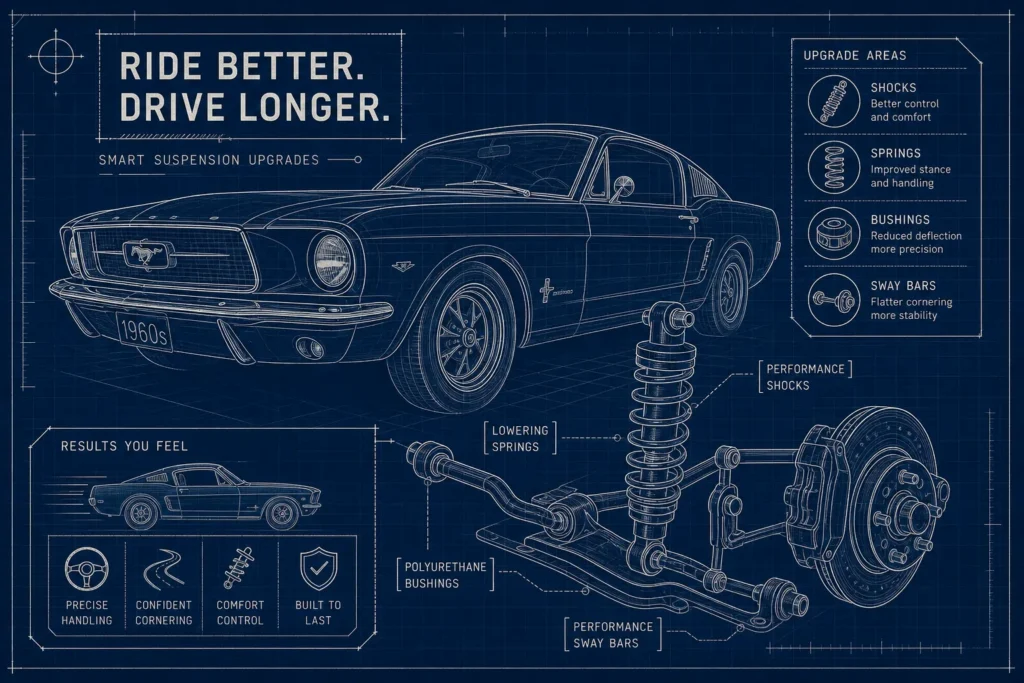
The suspension upgrades worth the money on a 1960s classic
If you’re asking what suspension upgrades are worth it on a 1960s American car, the answer depends on three things: what the car is, how you use it, and how much originality matters to you. A 1960s American muscle car was engineered for wide, straight, lightly trafficked roads. Put one in modern traffic, roundabouts, fast A-roads, motorway on-ramps, and the gap between expectation and reality becomes very clear, very quickly. The car floats, leans, and takes corners with all the precision of a fully laden barge. That is not a flaw in design; it is a reflection of when and where these cars were built.
At London Car Restorations, this is one of the most common conversations we have with owners arriving at our Fitzroy Street workshop. How much can you improve without losing what makes the car worth owning in the first place? This guide works through the classic car suspension upgrades that genuinely earn their cost, in order of impact, from the quick wins to the more involved commitments.
Why original 1960s suspension struggles on modern roads
The design philosophy behind 1960s American suspension was entirely deliberate. Long-travel springs tuned for boulevard comfort, skinny bias-ply tyres, minimal roll stiffness, and steering geometry optimised for low-effort cruising, these were features, not oversights. The result on a modern road is a car that understeers heavily, rolls through corners, and demands real commitment before it stops confidently.
The core problems are specific: excessive body roll through bends, vague steering response on turn-in, unpredictable weight transfer under hard braking, and worn rubber bushes that have long since crumbled to dust. Think of this as a diagnosis process. Fix the worst problems first, not the most exciting ones. That distinction matters more than most owners realise when they start researching coilovers online at midnight.
Many of these cars have also degraded significantly from their factory baseline. A 60-year-old car with original bushes, shocks and geometry has often drifted well below even the modest benchmark it left the factory with. Restoration-grade parts should generally come before performance upgrades. Fitting a performance sway bar to a car with shot bushes and tired shocks is roughly equivalent to fitting new running shoes to someone with a broken ankle.
What suspension upgrades are worth it on a 1960s American car, the high-return changes
The best muscle car suspension upgrades are often the cheapest. A larger front anti-roll bar, fresh performance shocks matched to the spring rate, and a full set of polyurethane bushes will transform how a 1960s classic behaves. Crucially, this combination replaces wearable components rather than altering the vehicle’s suspension type or structure, which means it generally does not affect the car’s historic MOT-exempt status and does not require a five-figure budget. It is worth noting, however, that some sway-bar mounts and aftermarket fitments can require minor modifications on specific platforms, so confirming compatibility with a specialist before ordering is always worthwhile.
One factor the priority list above cannot afford to ignore: modern radial tyres and correctly sized wheels are widely regarded by suspension engineers and classic car specialists as the single largest handling gain available to a 1960s American car. The skinny bias-ply tyre that these cars left the factory on provides a fraction of the lateral grip of a modern radial, and much of the benefit from every other suspension upgrade depends on the tyre being able to use it. Sorting the tyres and wheels alongside, or even before, the suspension work is not a concession to modernity; it is the foundation the rest of the programme sits on.
Anti-roll bars: the fastest way to reduce body roll
A larger front sway bar resists the body rolling onto the outside tyre through a corner, keeping the contact patch more consistent and the steering more predictable. Adding a rear bar improves balance and reduces the tendency to push wide on exit. Parts for a front-and-rear sway bar kit generally run from around £150 to £500 depending on the platform, with fitment adding roughly another £75 to £150 at a specialist workshop, a total all-in cost of roughly £250 to £900. The improvement in confidence is immediate. This is a reversible, sympathetic upgrade that the majority of 1960s American classics benefit from, making it one of the most consistent answers to what suspension upgrades are worth it on a 1960s American car.
Polyurethane bushes and performance shocks
Polyurethane bushes eliminate the slop in worn rubber, sharpening steering response and making the suspension behave as it was originally designed to. For a 1966 to 1968 Mustang, suppliers including Prothane and Energy Suspension offer front-end rebuild kits covering the lower control arms, strut rods, and sway bar mounts specifically for that platform. A full bush kit generally costs between £100 and £600 in parts, with labour adding another £200 to £800 depending on how much corrosion the workshop encounters.
Quality shocks, matched to the existing spring rates, control weight transfer without making the ride punishing. Together, these two changes often make a bigger real-world difference than a coilover conversion on a car with degraded original parts. Fix the baseline before adding performance.
When a coilover conversion is worth it on a 1960s American car
Coilovers are the upgrade owners tend to research first and fit second, the conversation with a specialist usually reveals there is groundwork to do first. That said, a coilover conversion can be genuinely transformative: sharper turn-in, adjustable ride height, predictable spring rates across the full suspension travel. The results are only reliable, though, when the rest of the suspension is sorted and the geometry supports it.
What a coilover conversion actually involves
Suppliers typically describe kits for 1960s GM A-body platforms and Mustang applications as near-bolt-in, but “near” matters. Year-range splits affect fitment: suppliers such as Helix Suspension and Global West divide their Chevelle kitsbetween the 1964 to 1966 and 1967 to 1972 chassis generations, and some kits assume aftermarket tubular control arms rather than stock geometry. Wheel clearance, alignment settings, and whether the kit works with your current spring rates all need checking before parts are ordered, and “bolt-in” can sometimes mean adapters, proportioning valves, or minor fabrication depending on the specific model and year. All-in costs for a coilover conversion generally run from around £650 to £3,000 or more at UK rates, depending on kit specification and the condition of the car going in. For a road-biased 1967 to 1972 Chevelle, recommended front spring rates sit around 450 lb/in for a small-block build and 550 lb/in for a heavier iron engine.
Restomod builds versus sympathetic upgrades
A full restomod suspension conversion is a different project from a sympathetic handling upgrade. Owners building a driver car may want the former; owners who care about value retention and concours originality usually want the latter. Both are entirely valid approaches, and we work on both at London Car Restorations. The question is not which approach is better, but which one matches what you actually want the car to be. Getting that clear before spending money saves a great deal of grief later.
Disc brake conversions: the safety upgrade most owners prioritise
If there is one modification that crosses the line from preference to necessity, it is switching from drum brakes to front discs. 1960s drum brakes were adequate for the era. They are not adequate for modern road speeds, traffic density, or the stopping distances that drivers around you will expect. A front disc brake conversion is not a performance modification; it is a safety baseline for any classic being used as a driver car.
Most 1960s American cars have bolt-in or near-bolt-in front disc conversion kits available, though fitment varies by model and year and some applications require adapters or minor fabrication. The conversion covers new calipers, rotors, a proportioning valve, and upgraded brake lines. A master cylinder upgrade is also required to handle the increased fluid demand. Parts generally cost between £400 and £2,000 depending on the platform and kit quality, with labour adding another £200 to £600. The real-world difference is meaningful: shorter stopping distances, more consistent pedal feel, and significantly less brake fade under repeated hard use, though the extent of those gains depends on tyre choice, pad specification, and overall system balance. The car becomes genuinely usable rather than something reserved for dry Sunday mornings on empty roads.
From a UK legality standpoint, a front disc brake conversion alone does not automatically affect a vehicle’s historic MOT exemption. Government guidance permits changes made to improve safety where they do not materially alter the vehicle’s basic character. A straightforward drum-to-disc upgrade on the front axle generally sits within acceptable territory, provided it is not part of a wider set of modifications that cumulatively trigger the “substantially changed” threshold. Individual assessment is always required, and cumulative modifications can shift that calculation.
How major changes affect value and UK road legality
This is the concern that separates UK-based classic owners from their American counterparts, and it deserves a direct answer. The DVLA operates a points-based system to assess whether a historic vehicle has been substantially changed. Suspension type is one of the systems assessed. An independent front suspension swap on a solid-axle car, for example, is a structural change to the type and method of suspension, exactly the kind of modification the DVLA may treat as substantial, which could push the vehicle toward a Q-plate and end its historic registration status. An IFS conversion is not a routine upgrade decision; it needs specialist guidance before any work begins.
Sympathetic upgrades, replacing bushes, fitting sway bars, upgrading to front disc brakes, generally do not cross this threshold when assessed individually. Classic car insurers also require suspension changes to be declared, as they can affect the agreed value and the underwriting position. For matching-numbers, investment-grade cars, any modification reduces the pool of buyers who will pay a premium. For driver-grade cars being built to use, a well-executed suspension upgrade often adds value by making the car genuinely capable on the road. The decision depends on what the car is, what it is worth, and what you want to do with it.
Deciding which upgrades are right for your build
The priority order is consistent regardless of model or budget: modern tyres and wheels first where the originals are bias-ply, then worn parts, then sway bars and poly bushes, then coilovers and disc brakes based on the build goal. Most builds follow a natural progression through three broad stages. A baseline refresh covering new bushes, matched shocks, and a front-and-rear sway bar upgrade generally costs between £800 and £1,500 all-in (workshop-typical estimates based on current UK parts and labour rates). Step up to include a front disc brake conversion and the total rises to roughly £1,400 to £4,100 depending on fitment complexity. A full restomod suspension package including coilovers and geometry correction starts at around £3,000 and climbs from there. Most owners work through these stages over time rather than tackling everything at once.
The right sequence also depends on what the specific car actually needs, which varies by model, year, current condition, and owner intent. At our Fitzroy Street workshop, we assess each car before recommending anything. Fitting coilovers to a car with shot geometry and worn bushes is money poorly spent. The conversation about what the car actually needs is always the right starting point, and it is one we are happy to have without any obligation to proceed.
Getting the sequence right from the start
The 1960s American car is worth upgrading precisely because it has the bones to respond well to the right changes. The factory engineers gave these platforms robust, well-designed architecture. What they lacked was modern tyre technology, quality damper control, and the anti-roll hardware that today’s roads demand. Done in the right order, a suspension upgrade programme makes a classic safer, more enjoyable, and more capable without compromising what it fundamentally is.
If you want to know what suspension upgrades are worth it on a 1960s American car, and want a realistic assessment of where your specific car should start, bring it in to London Car Restorations. We offer workshop assessments for exactly this kind of conversation: no pressure, no unnecessary work orders, just a straight answer about what your car needs and in what order. You can reach us directly through the contact page or call the workshop to arrange a time.